French
French in ten features
français
French spelling is a record of an older pronunciation, plus a few rules that tell you which silent letters wake up. Ten features cover a first conversation. Korean, if you are coming from Hangul and the week after it, glues grammar to the end of the verb. French puts it on the article. Spanish is the closer cousin: same gender habit, a louder spelling system.
Chinese, Japanese, and Korean will not help you with gender or agreement. They will help you notice that French politeness, like Korean 해요체, is a choice you make on purpose.
1. Gender

Every noun is masculine or feminine, including objects. The article is how you see it.
| Masculine | Feminine | |
|---|---|---|
| the | le café | la table |
| a | un café | une table |
| the, plural | les cafés | les tables |
Le and la become l' before a vowel sound: l'ami, l'école. Plural les does not care about gender. You hear gender in the singular article, and in the adjective that follows.
Learn the noun with its article. Table alone is not a vocabulary item. La table is.
- Fun fact: A few endings are reliable enough to trust on a guess. -tion, -sion, -té, -ette are feminine (la nation, la liberté). -age, -eau, -ment, -isme are masculine (le fromage, le gouvernement). Exceptions exist. The article you met in a sentence beats the suffix rule.
- Intermezzo: Professions after être usually drop the article. Je suis étudiant. Je suis étudiante. The gender moved onto the noun instead.
- Try: Point around a room. Le livre. La chaise. L'eau.
2. Liaison
A lot of final consonants are silent until the next word starts with a vowel. Then they pronounce, and they move onto that vowel. That join is liaison.
les amis — the s sounds like z: "lez ami". vous avez — the s does the same. un petit enfant — the t of petit wakes up.
Et is a wall. Un café et un croissant does not grow a z between et and un. If you add one, it sounds like a different word.
- Fun fact: Some liaisons are obligatory (after a determiner, after a pronoun, after a short adjective like petit), some are forbidden (after et), some are optional and a bit formal. Obligatory plus the et wall is enough for now.
- Intermezzo: Silent letters are why the spelling looks antique. The s in les is not decorative. It is waiting.
- Try: les amis, les écoles, vous avez. Then et un café, with no extra consonant.
3. tu and vous
Tu is one person you are allowed to be informal with. Vous is either one person you are keeping distance with, or more than one person no matter how close.
| One person | Several | |
|---|---|---|
| informal | tu | vous |
| distance | vous | vous |
Comment tu t'appelles ? Comment vous appelez-vous ?
Use vous with staff, strangers, anyone older until they offer tu. The offer is explicit: on peut se tutoyer. Switching by yourself is the mistake, same shape as Korean 반말.
- Fun fact: Vous takes a plural verb even when it means one person. Vous êtes, never vous es. The grammar is plural. The social meaning might be singular.
- Intermezzo: Names do less work than in Korean. Monsieur, madame, and the family name cover the distance that 씨 covers. Given names arrive with tu.
- Try: Bonjour, madame. Un café, s'il vous plaît.
4. Nasal vowels
An, en, on, in, ain often have no consonant n at all. The vowel itself is nasal. Bon, vent, nom, vin, pain. If you release a clean English n at the end, you have added a consonant the word does not have.
Un is its own nasal in careful speech. A lot of Paris speech folds un into the in of vin. You will be understood either way. Spelling still distinguishes them.
- Fun fact: Liaison can bring the n back. Bon alone is nasal, with no n. Bon ami pronounces the n, and the vowel usually stops being nasal. The silent letter woke up and changed the vowel on its way out.
- Intermezzo: M does this too, before p and b: chambre, impossible. Same nasal vowel, different spelling.
- Try: bon, pain, vin, nom. Then bon ami, and listen for the n.
Intermezzo — at the counter

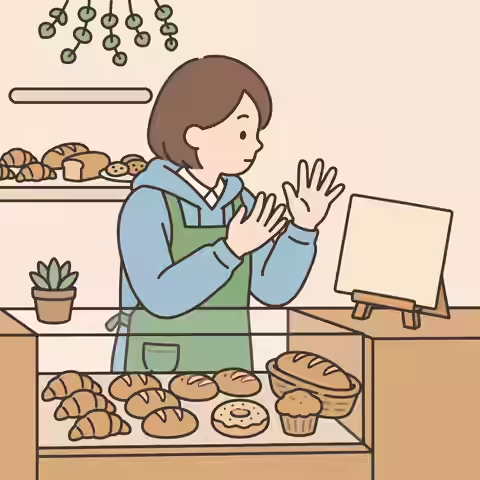
Bonjour. Je voudrais un café et un croissant, s'il vous plaît.
Vous, not tu. Un twice, masculine, because café and croissant are masculine. Et with no liaison. S'il vous plaît is the ordinary lubricant, closer to 주세요 than to a speech. Je voudrais is the conditional of vouloir, and it is the form to store as a chunk. The present je veux is grammatically fine and socially blunt at a counter.
5. au and du
À plus le contracts. De plus le contracts. La does not.
| Separate | Becomes |
|---|---|
| à + le | au |
| à + les | aux |
| de + le | du |
| de + les | des |
| à + la, de + la | à la, de la |
Je vais au café. Je viens du café. Je parle à la serveuse.
Du and des are also the "some" article. Je veux du pain. Du café. Des croissants. Part of a mass, or an unspecified plural.
- Fun fact: Des is the plural of un/une in that "some" sense, and also de + les. Context tells you which job it has. Je vois des amis (some friends). Je parle des amis (about the friends).
- Intermezzo: À la and de la stay open because la does not contract. People over-correct and invent à le. It is au.
- Try: au café, à la gare, du pain, de la tarte.
6. ne…pas
Negation wraps the conjugated verb. Ne on the left, pas on the right.
Je comprends. Je ne comprends pas. Tu as. Tu n'as pas. (ne becomes n' before a vowel)
In speech the ne often disappears: je comprends pas. Write the ne. Expect to miss it when you listen. Other second halves exist (jamais, rien, plus, personne). Pas is the one that means "not".
- Fun fact: With a plain infinitive, both halves sit in front. Ne pas fumer. The verb is not conjugated, so there is nothing to wrap.
- Intermezzo: Korean stacks negation on the verb (안 마셔요, 못 가요). French leaves the verb where it was and brackets it. Do not move the verb to find the "not".
- Try: Je ne sais pas. Then the thing you will actually hear: je sais pas.
7. Adjective seats
Adjectives agree with the noun: masculine, feminine, singular, plural. Petit, petite, petits, petites. Most of them follow the noun. Une table petite is grammatical and rare. The common ones often come first: petit, grand, bon, beau, joli, jeune, vieux, mauvais.
A few change meaning with the seat.
| Before the noun | After the noun |
|---|---|
| un ancien professeur — a former teacher | un bâtiment ancien — an old building |
| ma propre chambre — my own room | une chambre propre — a clean room |
| un grand homme — a great man | un homme grand — a tall man |
- Fun fact: Beau, nouveau, and vieux have a third form before a vowel: un bel ami, un nouvel ami, un vieil ami. The l is there so two vowels do not collide.
- Intermezzo: Agreement is audible mostly in pairs like petit/petite (the t is silent in the masculine, pronounced in the feminine) and in liaison from a plural s. A lot of written agreement is silent. You still write it.
- Try: un petit café, une petite table, mon propre livre, un livre propre if the book is actually clean.
8. Seventy to ninety-nine
France counts 70, 80, and 90 by arithmetic.
| France | |
|---|---|
| 70 | soixante-dix (60+10) |
| 71 | soixante et onze |
| 80 | quatre-vingts (4×20) |
| 81 | quatre-vingt-un |
| 90 | quatre-vingt-dix |
| 99 | quatre-vingt-dix-neuf |
Quatre-vingts keeps the s when nothing follows inside the number: quatre-vingts, quatre-vingts euros. The s drops as soon as the number continues: quatre-vingt-un, quatre-vingt-dix.
- Fun fact: Belgium and Switzerland usually say septante (70) and nonante (90). Much of Swiss French says huitante (80); Geneva often keeps quatre-vingts. A menu that says septante is not misspelled. France still uses the arithmetic.
- Intermezzo: Vingt et un, trente et un, with et only on the ones of the round ten, through 71 (soixante et onze). 81 is quatre-vingt-un, no et. 91 is quatre-vingt-onze, no et. The et stops at 71 in the French system.
- Try: Say 21, 70, 80, 81 aloud. Vingt et un. Soixante-dix. Quatre-vingts. Quatre-vingt-un.
9. Passé composé
Everyday past for a finished event is a helper plus a participle. Most verbs use avoir.
J'ai mangé. Tu as parlé. Nous avons fini.
A short list of motion and life verbs uses être instead: aller, venir, arriver, partir, entrer, sortir, monter, descendre, rester, tomber, naître, mourir, and the verbs built on them (revenir, devenir). Reflexives use être too. Je me suis levé.
With être, the participle agrees with the subject. Je suis allé. Je suis allée. Ils sont allés. Elles sont allées. With avoir, do not agree with the subject. J'ai mangé stays mangé for a woman. (Agreement with a preceding object exists. Skip it.)
- Fun fact: Passé composé is the past you want for "I did it". Imparfait is the other past, for background and habit (il faisait beau, je parlais). One event, one time: passé composé. The scene around it: imparfait. You can live on passé composé until that contrast shows up in a story.
- Intermezzo: The helper is conjugated. The participle is not. Je suis allée, not je suis allé suis. Negation wraps the helper: je n'ai pas mangé. Je ne suis pas allé.
- Try: J'ai mangé. Je suis allé, or allée. Je n'ai pas fini.
10. False friends
These words look like English and mean something else. The English guess is the error.
| French | It means | The English lookalike is actually |
|---|---|---|
| actuellement | currently, at the moment | vraiment, en fait |
| librairie | bookshop | bibliothèque |
| sensible | sensitive | raisonnable |
| demander | to ask | exiger, if you truly mean demand |
| préservatif | condom | conservateur, for a food preservative |
| charger | to load | (a person in charge is responsable) |
| rester | to stay | se reposer, for "have a rest" |
- Fun fact: Actuellement in a news sentence is "at present", never "in fact". En fait is the one that means actually.
- Intermezzo: Korean Konglish does this too: the sound is a loan, the meaning is local. French false friends are older and meaner, because the English word often came from French and then drifted.
- Try: Read actuellement as "right now" the next three times you see it, before the English reflex fires.
First week
- Ten nouns with their article, said as a unit. Five masculine, five feminine.
- Tu for one imagined friend, vous for everyone else. One order: je voudrais… s'il vous plaît.
- Ne…pas around three verbs you have. Write the ne. Then say it again the way speech does.
- 1–20, then 70, 80, 81, 90. Avoir-past for manger and faire. Être-past for aller, both genders if both apply to you.
Spanish shares gender, tu/usted, and a past built on "have". It spells the sounds French keeps silent. Korean shares the politeness problem and almost none of the grammar.